
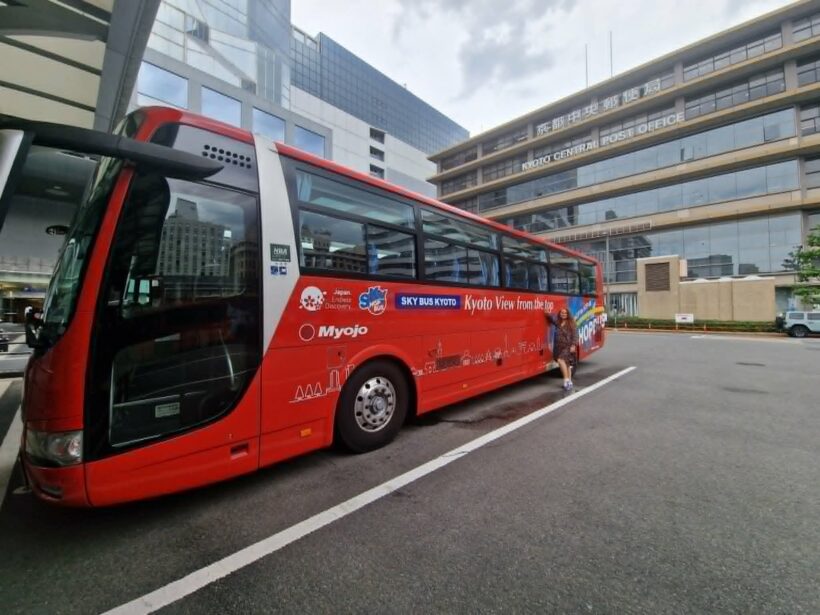
Is Sky Hop Bus Kyoto Worth It? Our Honest Review After Two Days of Using It
If you’re visiting Kyoto for the first time, chances are you’ve already come across Sky Hop Bus Kyoto, the city’s hop-on hop-off sightseeing bus. At first glance, it seems like a convenient way to visit Kyoto’s most famous temples, shrines, and historical districts without worrying about public transportation.
We ended up buying tickets too—but not for the reason you might expect. Before arriving in Kyoto, we made the same mistake many first-time visitors make: we assumed the city was relatively compact.
Since Kyoto was Japan’s imperial capital for more than a thousand years, we imagined that its temples, palaces, and historic neighborhoods were all located within walking distance of each other. We expected to spend our days wandering from one landmark to the next without much planning.


We couldn’t have been more wrong.
After our first day, we quickly realized that Kyoto is much larger than it looks on a map. That’s when we decided to use Sky Hop Bus Kyoto, and looking back, it was one of the best decisions we made during our trip. So, is it actually worth it?
After using the service for two full days, here’s everything we learned—what we loved, what we didn’t, and whether we’d buy the tickets again.
Kyoto Is Much Bigger Than It Looks
Although Kyoto often appears compact in travel guides, it is actually home to around 1.5 million people and covers a surprisingly large area. One of the biggest surprises for first-time visitors is that the city’s main attractions are spread across different districts rather than concentrated in one historic center.
We spent three days exploring Kyoto and, even after using Sky Hop Bus for two of them, we still couldn’t fit everything into our itinerary.
At first, we blamed our planning. Later, we realized there are historical reasons why Kyoto is laid out this way. Many of the city’s most famous temples were intentionally built in peaceful surroundings, away from the crowded center. Monks sought quiet locations on hillsides or surrounded by forests, where they could meditate and create beautiful gardens.
For example, Kiyomizu-dera overlooks Kyoto from the eastern hills, while Kinkaku-ji, the famous Golden Pavilion, was built within an elegant garden estate surrounded by ponds and trees.
Kyoto itself has also expanded dramatically over the centuries. Areas that were once on the outskirts of the city are now part of the modern metropolitan area. The same applies to the city’s palaces.
The Kyoto Imperial Palace served as the residence of Japan’s emperors for centuries, while Nijō Castle was built by the Tokugawa shogunate as a symbol of military power. They served completely different purposes, so there was never any reason for them to stand next to each other.
For today’s travelers, however, this historical development creates one obvious challenge: getting around takes much longer than expected.
Why Is Kyoto So Difficult to Explore?
If you’ve already visited Tokyo or Osaka, you’ll probably expect an equally efficient rail network.
Kyoto works differently. While the city does have a subway system, most famous attractions are reached by buses rather than trains. Those buses share the roads with regular traffic, which can become extremely busy, especially during cherry blossom season and autumn foliage.
Honestly, Kyoto was the place where we saw the most exhausted tourists during our entire trip to Japan. Everyone seemed to be rushing from one temple to another, trying to squeeze as much as possible into a limited amount of time.
The problem isn’t just the walking. It’s the constant combination of traffic, bus rides, transfers, and walking again before finally reaching each attraction. That’s why every hour you save can make a huge difference.
What Is Sky Hop Bus Kyoto?
Sky Hop Bus Kyoto is a classic hop-on hop-off sightseeing bus designed specifically for visitors.
The concept is simple. You board the bus, get off at the attractions you want to visit, explore them at your own pace, then hop back on the next bus when you’re ready to continue. The buses are double-deckers, and if you manage to grab a seat upstairs, you’ll enjoy some fantastic views while traveling through Kyoto.
Each bus also offers:
- multilingual audio guides;
- free onboard Wi-Fi;
- easy access to many of Kyoto’s most popular tourist attractions.
For first-time visitors, it removes much of the stress that comes with figuring out Kyoto’s public transportation system.


How Much Does Sky Hop Bus Kyoto Cost?
Sky Hop Bus usually offers 1-day and 2-day passes, with discounted fares for children. We chose the two-day pass, and after experiencing Kyoto firsthand, we believe it was the right decision.
If you’re planning to visit several major attractions over just two or three days, the extra cost compared to public transportation is easily justified by the amount of time you’ll save. That said, ticket prices and schedules may change throughout the year, so it’s always worth checking the official website before your trip.
Sky Hop Bus Kyoto Routes
Sky Hop Bus currently operates two sightseeing routes covering most of Kyoto’s central and northern attractions.
Blue Line (East Line)
The Blue Line serves eastern Kyoto and stops near several famous attractions, including:
- Kyoto Station
- Nishiki Market
- Kyoto City Hall
- Ginkaku-ji (Silver Pavilion)
- Heian Shrine
- Gion
- Gojozaka (for Kiyomizu-dera)
Red Line (West Line)
The Red Line focuses on western and northwestern Kyoto, with stops including:
- Kyoto Station
- Nijō Castle
- Kyoto Imperial Palace
- Kinkaku-ji (Golden Pavilion)
Which Attractions Are Not Included?
Although the routes cover many of Kyoto’s highlights, two major attractions are missing:
- Fushimi Inari Taisha, famous for its thousands of vermilion torii gates;
- Arashiyama Bamboo Grove, one of Japan’s most photographed bamboo forests.
Fortunately, both destinations are easy to reach by JR train or local transportation from Kyoto Station, so visiting them on a separate day is usually the best option.
Our Experience Using Sky Hop Bus Kyoto
One thing worked in our favor from the very beginning: our hotel was just a short walk from Kyoto Station, where the Sky Hop Bus starts its route. Even so, we quickly realized that exploring Kyoto requires much more planning than we had expected.
It wasn’t enough to decide which attractions we wanted to visit. We also had to keep an eye on the bus routes, departure times, and how long we wanted to spend at each stop. After only a few hours in the city, it became clear that Kyoto isn’t the kind of destination where you can simply wander around and expect to see everything.
The distances between major attractions are surprisingly long, and one wrong decision—missing a bus or getting off at the wrong stop—can easily cost you an hour.
Over the two days we used Sky Hop Bus, we managed to visit:
- Kinkaku-ji (the Golden Pavilion)
- Kyoto Imperial Palace
- Nijō Castle
- Nishiki Market
- Gion District
- Ginkaku-ji (the Silver Pavilion)
At first glance, that might not seem like a long list. But once you arrive in Kyoto, you’ll quickly understand why. These aren’t attractions you can visit in ten or fifteen minutes. Most temples have extensive gardens, beautiful walking paths, museums, and historic buildings that deserve more than a quick photo stop.


One of the things we appreciated most was how easy it was to move between attractions. Instead of constantly checking Google Maps or trying to figure out which local bus to catch next, we simply got off near the places we wanted to visit, explored them at our own pace, and boarded the next Sky Hop Bus when we were ready to continue. That convenience made our days far less stressful.
The One Major Attraction We Missed
Ironically, despite using the sightseeing bus for two days, we still missed one of Kyoto’s most famous landmarks: Kiyomizu-dera.
The Sky Hop Bus stops at Gojozaka, but from there it’s about a ten-minute uphill walk to the temple. Unfortunately, we didn’t realize we had reached the correct stop until it was too late. It was entirely our mistake, but it also taught us an important lesson: in Kyoto, planning really matters.
When attractions are spread across such a large area, even a small oversight can mean missing one of the city’s highlights. On the bright side, it gave us the perfect excuse to return to Kyoto someday.
What Can You Visit in One Day with Sky Hop Bus?
If you start early from Kyoto Station and organize your time well, it’s possible to visit several of the city’s top attractions in a single day without feeling rushed. A realistic itinerary could look like this:
- Kinkaku-ji (Golden Pavilion)
- Kyoto Imperial Palace
- Nijō Castle
- Nishiki Market
- Gion District
This is almost exactly the route we followed, and it felt like the perfect balance.
We had enough time to explore each attraction, take plenty of photos, stop for lunch, and enjoy the atmosphere without constantly watching the clock. Of course, you could try to fit more into one day. But in our opinion, that’s not the best way to experience Kyoto.
This is a city that rewards slow travel. Some of our favorite moments weren’t inside temples at all—they happened while wandering through quiet streets, discovering hidden cafés, or simply sitting in a peaceful garden.
Why We Think Sky Hop Bus Kyoto Is Worth It
After using the service for two days, the biggest advantage was obvious: it saved us a significant amount of time. Yes, the ticket costs more than using local buses. But when you’re only spending two or three days in Kyoto, time is far more valuable than the money you save by choosing the cheapest option.
Here are the benefits we noticed the most:
- You don’t need to learn Kyoto’s sometimes confusing bus network.
- Most of the city’s major attractions are easy to reach.
- The upper deck offers fantastic panoramic views during the journey.
- The onboard audio guide provides useful background information about the city.
- It’s an excellent choice for first-time visitors.
- It makes planning your sightseeing much simpler.
Perhaps the biggest benefit, though, was peace of mind. Instead of worrying about transportation, we were able to focus on enjoying Kyoto itself.


Sky Hop Bus vs. Public Transportation
One question almost every traveler asks is whether Sky Hop Bus is actually better than Kyoto’s public transportation. The honest answer is: it depends on your travel style.
If you’re traveling on a tight budget and have plenty of time, Kyoto’s buses and trains are perfectly capable of getting you almost anywhere in the city. However, they do require more planning. You’ll often need to transfer between different bus lines, check schedules, and navigate unfamiliar routes.
If it’s your first time in Kyoto and your goal is to visit as many famous attractions as possible in just a few days, Sky Hop Bus makes the experience much easier. You simply board the bus, enjoy the ride, get off where you want, and continue whenever you’re ready. That convenience alone made the extra cost worthwhile for us.
Of course, Sky Hop Bus isn’t a complete replacement for public transportation. You’ll still need trains or local buses to visit places like Fushimi Inari Taisha or Arashiyama Bamboo Grove.
But for exploring Kyoto’s historic center and many of its most famous landmarks, we found it to be one of the easiest and most enjoyable ways to get around the city.